


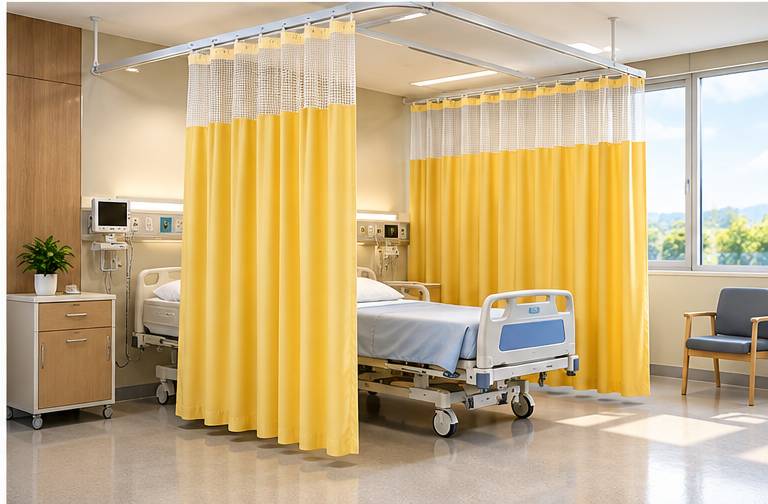
The Role of Hospital Curtains in Maintaining Patient Privacy and Hospital Hygiene
A hospital environment should be designed to help patients feel more comfortable and secure while receiving medical care. Hospital curtains are practical elements of healthcare facility design, used to separate beds, provide privacy, and improve the organization of medical spaces. The Importance of Privacy in Hospitals Patients in inpatient wards, emergency departments, and examination rooms need spaces where medical care can be provided while maintaining their privacy. Hospital curtains create flexible partitions that limit direct visibility of patient beds. When installed correctly, they also allow healthcare professionals to access patients quickly. This feature is particularly important in departments where multiple beds are located within a shared space. The Impact of Hospital Curtains on Environmental Hygiene Hospital curtains may come into contact with hands, medical equipment, or surrounding surfaces during use. Therefore, selecting suitable fabric and following an appropriate cleaning schedule are essential. To help maintain a hygienic environment, healthcare facilities should implement the following measures: - Establish a clear schedule for curtain cleaning and washing. - Follow the manufacturer's instructions for washing and disinfection. - Replace contaminated or damaged curtains according to facility protocols. - Regularly inspect the fabric, stitching, tracks, and fittings. - Select products that meet the infection-control requirements of each department. It is important to remember that no curtain can replace proper environmental cleaning, hand hygiene, or other essential infection-control measures. Differences Between Ordinary Curtains and Curtains Designed for Healthcare Facilities Curtains used in healthcare facilities should be selected according to the conditions of their intended environment. Compared with ordinary decorative curtains, hospital curtains should be evaluated for durability, ease of cleaning, installation requirements, and safety standards.
In some departments, curtains with fire-retardant properties or other specialized features may be necessary. These specifications should be assessed based on recognized standards, product documentation, and the regulations applicable to the intended location. How to Extend the Service Life of Hospital Curtains Proper maintenance can help preserve curtain quality. Washing according to recommended procedures, avoiding excessive pulling, periodically inspecting the track system, and replacing damaged components promptly are all effective maintenance practices. Curtains should also be inspected according to their frequency of use and the conditions of each department. This helps ensure that cleaning or replacement takes place whenever necessary. Conclusion Hospital curtains are more than simple fabric partitions. They are practical components of healthcare equipment that support patient privacy, environmental organization, and cleaning procedures in medical facilities. Choosing suitable products and maintaining them properly can help create a safer and more comfortable environment for both patients and healthcare professionals.